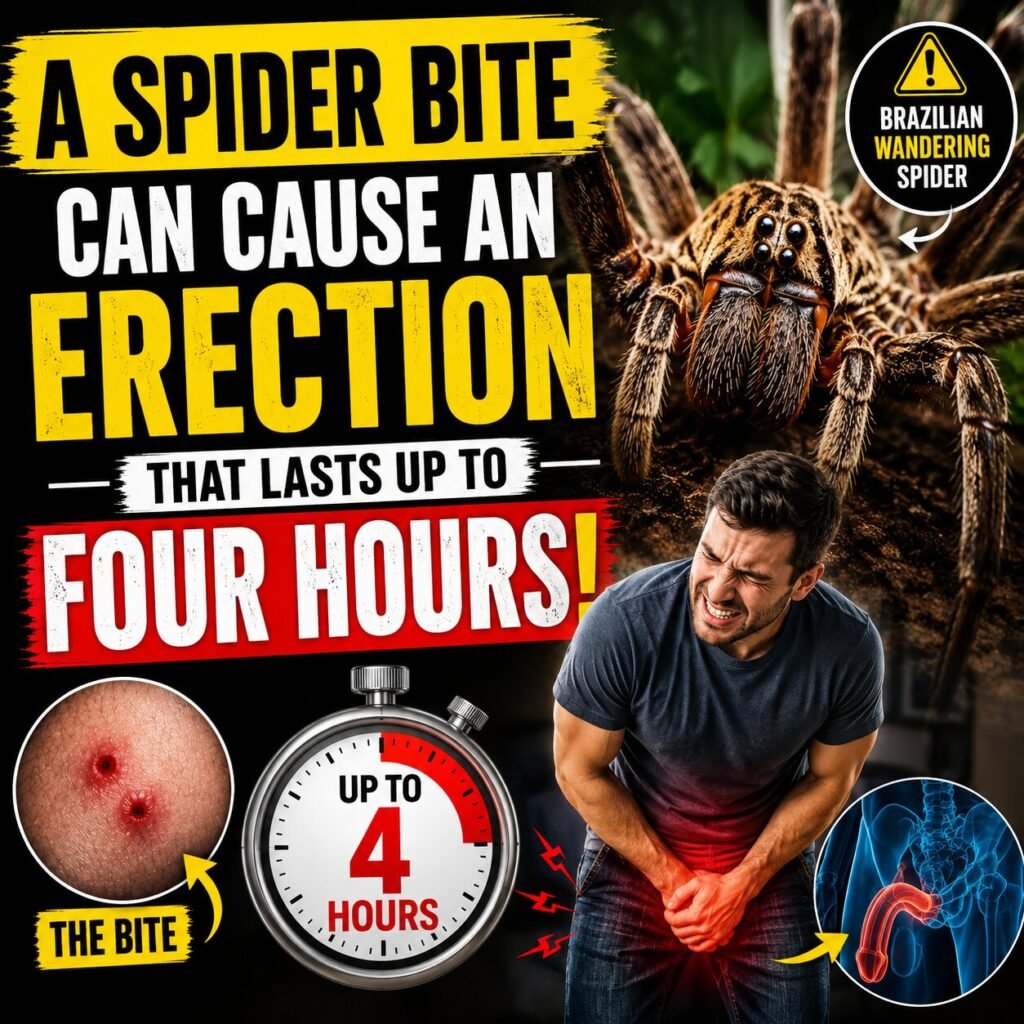
Imagine being bitten by a spider and expecting pain, swelling or maybe a little swelling around the bite.
Instead, something much stranger happens.
You develop an involuntary, painful erection.
It sounds like one of those bizarre internet facts that couldn’t possibly be true.
But in this case, scientists have documented it.
The culprit is the Brazilian wandering spider, a highly venomous spider belonging to the Phoneutria genus. Its venom contains toxins that can affect the body’s nervous and vascular systems — and one particularly unusual effect is priapism.
The Bite That Caused Something Nobody Expected
One documented case involved a 52-year-old man who was bitten on the neck by a female Phoneutria nigriventer while working in a public garden.
The bite was extremely painful.
But the symptoms didn’t stop there.
He developed blurred vision, intense sweating, tremors and vomiting. His blood pressure rose dramatically, and he became agitated.
Then came the strangest symptom.
Four hours after the bite, doctors recorded priapism.
Priapism is not simply a normal erection. It is a prolonged, involuntary erection that can become painful and requires medical attention.
The man was treated with antivenom and supportive treatment, and his symptoms largely disappeared within about an hour after treatment. He was discharged two days later without reported lasting complications.
So Why Does This Spider Do That?
This is where the story gets even more fascinating.
Researchers discovered that the spider’s venom contains several powerful toxins.
One of the most studied is known as Tx2-6, or PnTx2-6.
Research has shown that this toxin can affect sodium channels and pathways involving nitric oxide and cyclic GMP, biological mechanisms that are also important in controlling erections.
In laboratory studies, the toxin produced priapism in mice and affected erectile function.
So the bizarre symptom isn’t simply an urban legend.
There is a biological mechanism behind it.
And Then Scientists Had a Strange Idea
Here’s the twist.
Instead of simply asking how to stop the venom from causing erections, researchers began asking:
Could understanding this venom help people who can’t get erections?
It sounds ridiculous.
Why would scientists study a dangerous spider venom as a possible treatment for erectile dysfunction?
Because the same biological pathways that produce an unwanted erection can potentially teach researchers something about how normal erectile function works.
Researchers have investigated venom-derived molecules and synthetic versions inspired by the spider’s toxins as possible tools for studying — and potentially treating — erectile dysfunction.
Scientists Didn’t Turn Spider Venom Into Viagra
This is an important distinction.
You may see viral posts claiming that scientists discovered a “natural Viagra” inside a spider.
That’s misleading.
The research is largely preclinical, involving purified toxins, laboratory experiments and animal models.
Researchers have developed synthetic peptides inspired by the venom, including PnPP-19, which has shown erectile-function effects in experimental studies. But that does not mean spider venom is a safe human treatment.
In fact, the venom itself can be dangerous.
The Spider Isn’t Giving Anyone a “Free” Erection
The viral version of the story can make the phenomenon sound almost funny.
It isn’t.
A serious Phoneutria envenomation can cause severe pain and other systemic symptoms, and the venom can affect the cardiovascular and nervous systems. Priapism following a bite is a medical complication, not a benefit.
And researchers studying the venom aren’t suggesting that anyone should deliberately expose themselves to it.
Quite the opposite.
They’re trying to understand why these toxins have such unusual effects.
The Most Bizarre Part of the Story
Think about how strange the scientific journey is:
A spider developed venom to defend itself and immobilize threats.
One component of that venom can cause an involuntary erection.
Scientists investigated the biological mechanism behind it.
And eventually, researchers began asking whether that same mechanism could teach them something about erectile dysfunction.
In other words, something potentially dangerous in a spider’s venom may contain clues about a problem that affects millions of men.
The Bottom Line
Yes, the viral claim has a real scientific foundation.
The Brazilian wandering spider Phoneutria nigriventer has venom associated with priapism, and a documented human case recorded the condition following a bite.
But the popular internet version leaves out the most important detail:
The erection isn’t a “benefit” of the bite. It’s a potentially serious symptom of envenomation.
The truly fascinating part is what happened afterward.
Scientists began studying the venom not because getting bitten is somehow useful — but because understanding its unusual effects could potentially reveal new ways of manipulating the biological pathways involved in erectile function.
A spider bite causing an erection sounds like a joke. The science behind it is anything but.