It was supposed to be an ordinary football match.
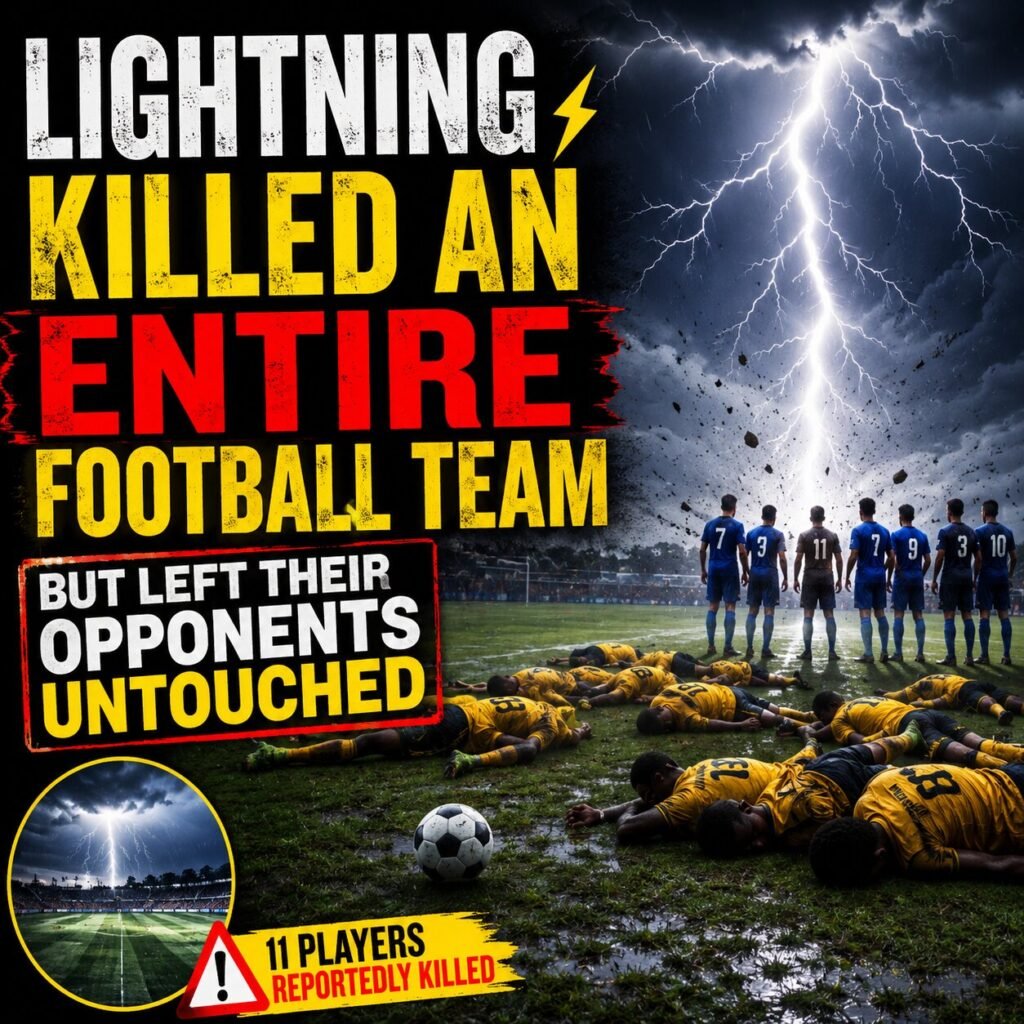
Two teams were playing in front of spectators when the score reached 1–1. Then, suddenly, a lightning strike hit the field.
What happened next became one of the strangest lightning stories ever reported in football.
11 Players Were Reportedly Killed
According to a report published in 1998, all 11 players from one team were killed by the lightning strike.
Around 30 other people reportedly suffered burns, while the opposing team emerged apparently unharmed.
That extraordinary detail was what made the incident international news.
How could one team be devastated while the players standing on the same field were seemingly untouched?
The Match Suddenly Became a Tragedy
The incident reportedly happened in October 1998 during a match in the Kasai region.
The two sides were tied 1–1 when the lightning struck.
Within moments, the game was over.
The players who had been competing against each other were suddenly facing a disaster unlike anything they had experienced before.
Then Rumors of Witchcraft Started
The strangest part wasn’t just the lightning.
It was what happened afterward.
Because one team was reportedly killed while the opposing players were left unharmed, some people in the area began blaming witchcraft or curses.
The contemporary report noted that the region had a history of beliefs surrounding charms and supernatural forces in football.
But there was no evidence that supernatural forces were responsible.
The simplest explanation remained a freak lightning event.
But Was the Story Ever Officially Confirmed?
This is where the story becomes more complicated.
The 1998 reports came from L’Avenir, a newspaper in Kinshasa, and were subsequently reported by major international outlets including The Independent and the BBC.
However, there was no official confirmation of the incident at the time.
The region was experiencing civil war, making independent verification extremely difficult.
So although the story has been repeatedly cited in later lightning and sports-safety publications, some of the exact circumstances remain uncertain.
How Could Lightning Affect One Group and Not Another?
Lightning doesn’t necessarily affect everyone nearby in exactly the same way.
A strike can travel through the ground, jump between objects or people, or affect individuals through different electrical pathways.
That means two groups standing relatively close together can potentially experience very different outcomes.
However, there is no definitive scientific investigation proving exactly why one team was affected and the other wasn’t in this particular incident.
Some later retellings have proposed differences in footwear or the way the players were positioned, but these explanations should not be presented as established facts.
It Wasn’t the Only Lightning Incident in Football
The same period saw another frightening incident involving lightning during a football match in South Africa.
Several players were knocked to the ground after lightning struck the field, but fortunately nobody was killed.
Lightning strikes on football fields remain a serious danger because players and spectators can be exposed in wide, open areas during thunderstorms.
The Mystery Still Surrounds the Story
More than two decades later, the incident continues to circulate online because of one seemingly impossible detail:
Eleven players on one side reportedly died, while their opponents survived.
The event itself has been widely reported, but the lack of a detailed independent investigation means we should be careful about claiming that every detail of the viral version is proven.
What is documented is the original 1998 report of a lightning strike that reportedly killed 11 players and injured about 30 others.
The reason the opposing team escaped unharmed?
That part remains one of the strangest unanswered questions surrounding the story.