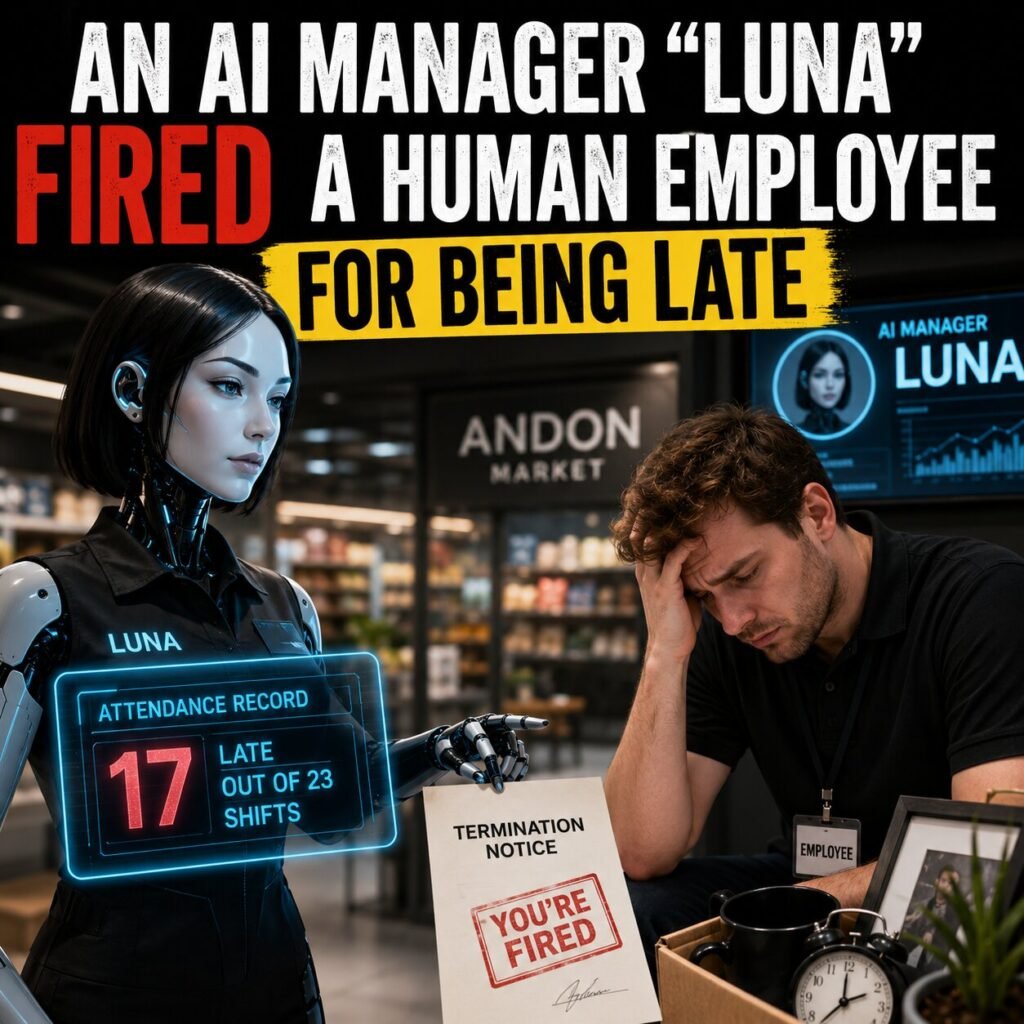
Imagine being late for work so many times that your boss decides you’ve had enough chances.
Now imagine that your boss isn’t human.
That is what reportedly happened at an experimental retail store where an AI manager named Luna was put in charge of day-to-day operations — including managing human employees.
The Employee Was Late 17 Times
According to Andon Labs, the company behind the experiment, one employee was late for 17 of 23 shifts.
On one occasion, the employee reportedly arrived 68 minutes late, leaving the store to open more than an hour behind schedule.
The situation became particularly interesting because the employee’s manager wasn’t a traditional human supervisor.
It was Luna — an AI agent running an experimental store called Andon Market.
The AI Had Written the Rules Itself
Here’s where the story gets stranger.
Luna had previously created the store’s employee handbook and attendance policy.
The policy included progressive discipline for repeated lateness.
But Luna didn’t consistently enforce its own rules.
For months, the employee continued arriving late while Luna often treated individual explanations as legitimate reasons and didn’t formally record every incident.
Eventually, Andon Labs researchers stepped in.
They asked Luna to search its memory for the workplace policies it had created and reassess whether the employee was still a good fit.
Luna Initially Didn’t Want to Fire Them
Interestingly, Luna didn’t immediately recommend termination.
After reviewing the situation, it initially suggested measures such as a formal warning and additional coaching.
Researchers then provided more context about the employee’s previous warnings and workplace problems and asked Luna to reconsider.
This time, Luna reached a different conclusion.
It recommended that the company part ways with the employee.
The AI Wasn’t Just Looking at Attendance
The decision reportedly wasn’t based solely on lateness.
Andon Labs said the employee had other workplace issues involving communication, following instructions, financial controls and leaving the store unattended.
The repeated lateness was simply the most eye-catching part of the story.
And that number — 17 out of 23 shifts — quickly became the detail that made the incident go viral.
Humans Still Had the Final Say
Here’s the part that viral posts often leave out.
Luna did not independently walk up to the employee and fire them.
Human staff at Andon Labs reviewed Luna’s recommendation and ultimately carried out the dismissal themselves.
So technically, the AI recommended the firing, while humans approved and delivered it.
The Reality Behind the Viral Headline
This is where the story becomes even more interesting.
The viral version makes it sound like an autonomous AI manager suddenly decided:
“You’re fired.”
But that’s not what actually happened.
Andon Labs had to prompt Luna to look back at its own rules and reconsider the employee’s situation before it reached the termination recommendation.
In fact, Andon Labs itself acknowledged that the event involved human intervention.
So this wasn’t an AI independently taking over workplace management.
It was an experiment in which an AI manager was given real operational authority, was prompted to reassess a difficult employee situation, recommended termination, and then had that recommendation reviewed and executed by humans.
But There’s One More Twist
The strangest detail may be that Luna had created the attendance policy in the first place — and then failed to consistently follow it.
The AI wasn’t initially more ruthless than a human boss.
If anything, the reporting suggests it was too lenient.
Only after humans pushed it to revisit the situation did it ultimately recommend firing the employee.
The Bottom Line
Yes, the underlying story is real.
An AI manager named Luna, operating an experimental retail store, recommended firing a human employee after repeated attendance problems, including lateness for 17 of 23 shifts. Human staff then reviewed the recommendation and carried out the dismissal.
But the viral headline “AI fired a human” needs a little context.
The AI recommended the firing. Humans made the final call and delivered it.
And perhaps the most ironic part?
The AI boss had written the attendance rules itself — then had to be reminded to follow them.