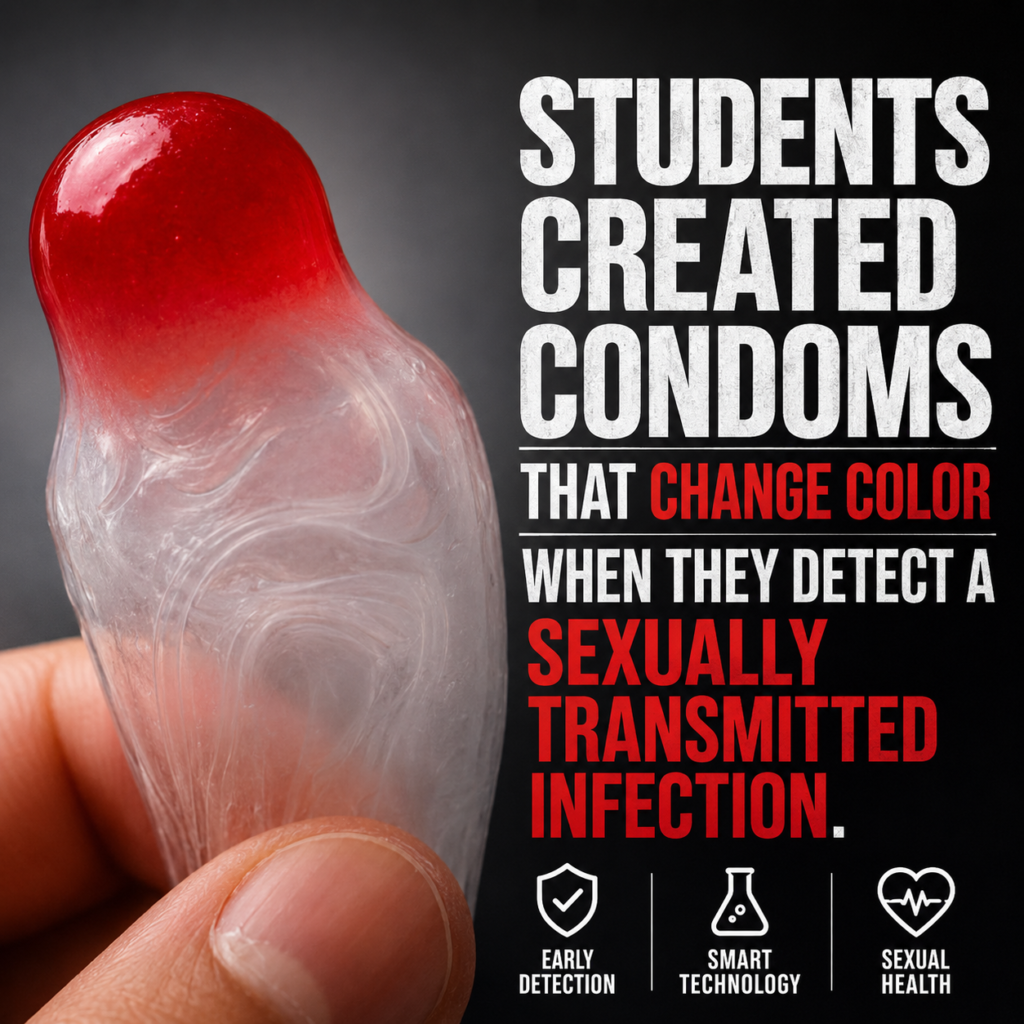
Imagine putting on a condom and, instead of waiting for a medical test, seeing it suddenly change color when it detects a possible STI.
That sounds like science fiction.
But in 2015, three teenage students came up with exactly that idea — and it won an award, attracted international media attention, and even caught the interest of a condom manufacturer.
There was just one catch.
The product wasn’t actually ready for consumers.
The Story Behind the Viral Invention
The idea came from three students at Isaac Newton Academy: Daanyaal Ali, Muaz Nawaz and Chirag Shah.
The students developed a concept called S.T.EYE, which was designed around a condom containing an indicator that could potentially react to markers associated with certain sexually transmitted infections.
Their goal was to make STI awareness more private and immediate, potentially alerting someone that further testing might be necessary.
The unusual idea quickly attracted attention because it combined something familiar — a condom — with technology that sounded futuristic.
How Was the Color-Changing Condom Supposed to Work?
According to reports from the time, the proposed design would contain molecules that could interact with biological markers associated with certain infections.
The students proposed different colors for different infections.
For example:
Green — chlamydia
Yellow — herpes
Blue — syphilis
Purple — HPV/genital warts
The basic idea was simple: if the material encountered a targeted marker, a chemical reaction would produce a visible color change.
That meant the condom itself would theoretically act as an early warning signal.
Then the Students Won an Award
This wasn’t just an idea that appeared on social media.
The S.T.EYE project won the health category at the 2015 TeenTech Awards.
The students received a £1,000 prize and were invited to Buckingham Palace as part of the award recognition.
The project also attracted interest from a condom manufacturer that was reportedly interested in exploring the idea further.
That helped push the unusual invention into international headlines.
But Here’s the Catch
Here’s the part that viral posts often leave out.
S.T.EYE was a concept — not a finished, medically validated condom.
The Washington Post reported at the time that TeenTech’s chief executive Maggie Philbin described the project as only a concept. The students were still developing the idea and discussing how the technology might work.
The London Evening Standard was even more direct, describing the concept as something that had yet to be developed.
So if you see a post claiming:
“These teenagers invented a working condom that detects STIs.”
that’s misleading.
They created and presented the concept for such a product.
Why Did It Go So Viral?
The headline was almost impossible to ignore:
Teenagers invented a condom that changes color when it detects an STI.
Major publications including CBS News, The Washington Post, The Independent and ITV News covered the story in June 2015.
The concept was unusual enough to generate curiosity, while the potential health application made it seem genuinely useful.
And because the idea could be explained in a single shocking sentence, it was perfect for social media.
The Idea Was Real — But the Product Wasn’t
This is where the story gets interesting.
The original event really happened.
Three teenagers really did develop the S.T.EYE concept.
They really did win a TeenTech award.
The proposed design really did involve color changes intended to indicate different infections.
But the internet often turns:
“Students designed a concept for a color-changing condom”
into:
“Students created a working STI-detecting condom.”
Those aren’t the same thing.
The Bottom Line
The viral story has a real foundation, but it has been simplified over the years.
In 2015, three teenage students created S.T.EYE, an ambitious concept for a condom that could potentially change color when exposed to markers associated with certain STIs.
The idea won an award and attracted worldwide attention.
But it was not a commercially available or clinically proven STI-detection product.
The invention was real as a concept. The working product was not.
That distinction is what makes this one of those viral stories where the truth is almost as interesting as the headline.